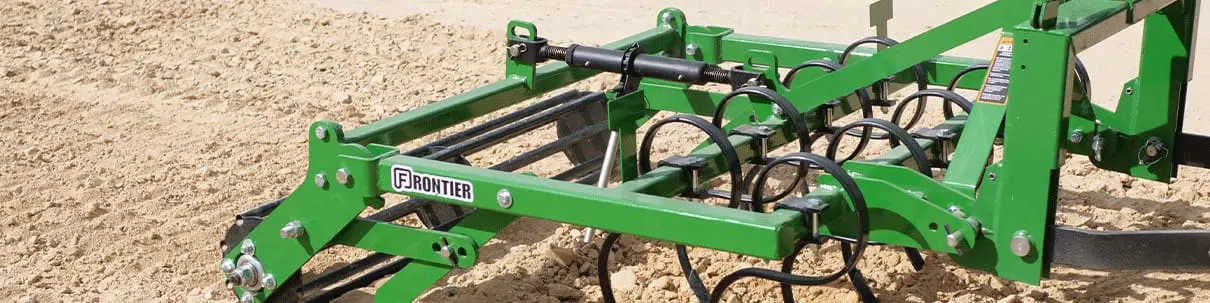
Few things are more important to a good crop than how you start out. Making sure that the soil is ready to sow takes a lot of work. Making sure that you have the right equipment to get it done should not.
For food plots and pastures, this conversation typically boils down to two options: a grain drill or a broadcast spreader. In this blog, we’ll break down the differences, pros and cons of these two implements.
Want to talk to a professional about spreaders and drills?
Before You Read Further
If you are new to maintaining grass crops, be sure to check with your local extension for information on soil and water best practices, grasses that will grow well, pest management and other details specific to your area.
Broadcast Spreaders Overview
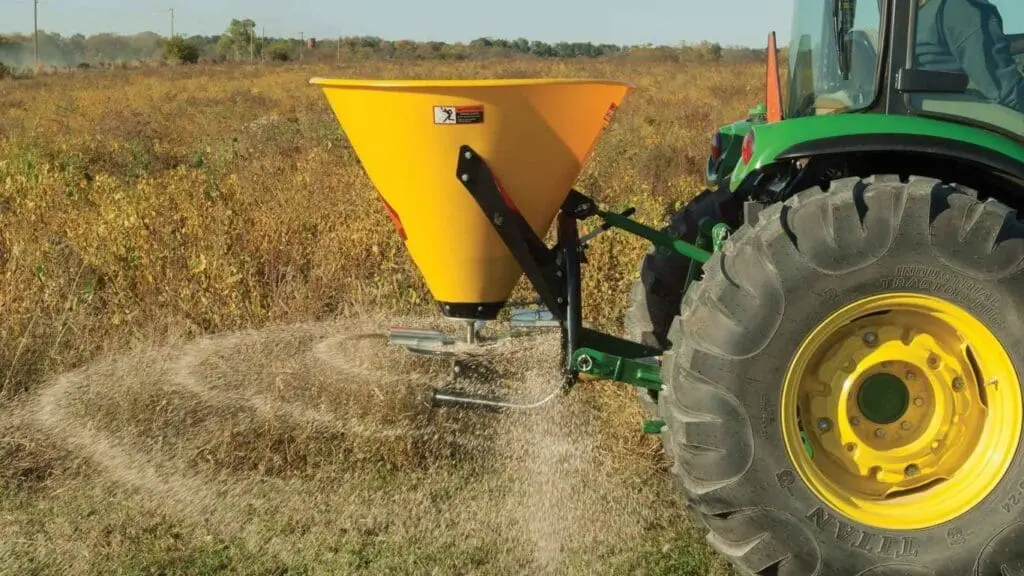
Broadcast spreaders are a cost-effective implement, great for planting and fertilizing lawns, food plots and pastures. These are simple machines with a hopper (to hold material) and a spinning disc with fins that flings (or broadcasts) the material outward. They come in many sizes, from small, hand cart-style spreaders, to large spreaders mounted on trucks and tractor frames.
One of the most common formats of broadcast spreader is attached to the 3-point hitch and PTO of a utility tractor.
Pendular spreaders are a similar implement that uses an arm slinging quickly from side to side to scatter seed.
Drills
At the most basic level, a drill is a type of planter that “drills” seeds directly in the ground in rows, rather than scattering them on top of it, requiring little to no tillage. Today, no-till planting is a major method of planting large crops in the U.S. Drills come in a variety of sizes as well, from small, tow-behind options for utility vehicles, to large, folding agricultural drills for row crop operations.
Differences In Functionality
The most obvious difference between drills and broadcast spreaders is the pattern of planting – spreaders spread material in a radial pattern while drills plant seeds in rows.
Because drills place seed directly into the ground, seeds are generally able to take root more effectively when the drill is set to the correct depth. However, planting this way is slower and requires more thorough calibration.
Spreaders, on the other hand, broadcast seed in a radial pattern, with less specific calibration for volume and almost no calibration for depth and spacing. They can often be run a bit quicker through a plot, but require soil aeration or some sort of drag implement to push the seed into better contact with the soil. Disking beforehand can be a good as well too.
Advantages Of Broadcast Spreaders
This is not an exhaustive list, but some of the major pros of spreaders are that they:
- Are cost effective.
- Can be used to spread a variety of materials like seed and fertilizer.
- Are the “quicker” option.
- Have fewer moving parts for simpler repairs and maintenance.
Advantages Of Drills
- More complete seed contact with soil.
- May be adjustable for seed rate and depth.
- Tend to require less field prep, causing lower compaction.
- Require less post-planting cultivation.
Popular Frontier Broadcast Spreaders
| Spreader Model Number | Hopper Capacity | Volume Capacity | Working Width | Tractor Horsepower Range | Hitch Type | Hopper Material | |
| SS1036B | 362 lb | 5.6 cu ft | 23 ft (7 m) swath | 16-45 hp | 3-point, Category 1 | All Steel | |
| SS1067B | 678 lb | 10.6 cu ft | 46 ft (14 m) swath | 16-55 hp | 3-point, Category 1 | All Steel | |
| SS2036B | 362 lb | 5.6 cu ft | 23 ft (7 m) swath | 16-45 hp | 3-point, Category 1 | Polyethylene (Resists Moisture & Chemicals) | |
| SS2067B | 678 lb | 10.6 cu ft | 46 ft (14 m) swath | 16-55 hp | 3-point, Category 1 | Polyethylene (Resists Moisture & Chemicals) | |
| SS3067B | 860 lb | 10 cu ft | 49 ft swath | 20-60 hp | 3-point, Category 1 | Polyethylene (Resists Moisture & Chemicals) | |
Planting Solutions At TriGreen Equipment
Ready to start planting your pasture or plot? Visit one of our 28 locations across North Alabama and Middle Tennessee to find the planting solution that best suits your needs!